Brahma Muhūrta is the last portion of the night just before dawn, considered highly conducive for meditation, japa, and other spiritual practices. Ideal for clarity of mind and concentration.
Time : 1 hour 36 minutes before sunrise. Often considered the penultimate prahara of the night.
Significance : Shastra mandates one to wake up at this hour. Most auspicious period for spiritual practice, meditation, and japa. The mind is calm and senses are subdued.
These timings are computed according to traditional shāstric markers and modern astronomical standards.
Visual (Apparent) Sunrise/Sunset: The primary standard used in this app. It accounts for atmospheric refraction and represents the moment the Sun’s first rays become visible (Sūrya-sahita).
Astronomical (Geometric) Sunrise/Sunset: Shown in parentheses, this represents the exact moment the Sun’s center physically crosses the mathematical horizon (0° altitude) in the Khagola.
Solar Noon: The precise instant the Sun reaches its highest point in the sky for your location.
Sandhyā timings in this app follow the visual markers defined in texts like Smriti Chandrika and Muktaphalam, which prioritize the perception of stars and solar visibility over hidden geometric positions.
Prātaḥ Sandhyopāsana is the morning twilight ritual performed at the junction of night and day. It is a nitya karma centered on Gāyatrī japa, beginning 48 minutes before sunrise and lasting until sunrise.
Divisions
Uttama-kāla : Stars visible; ideal.
Madhyama-kāla : Stars vanished; sunlight not yet appeared; acceptable.
Adhama-kāla : First rays touch horizon; least ideal but still permissible.
Madhyahnika is the midday ritual observed around solar noon. Though short, it is an important practice to align one’s duties with the daily rhythm and maintain spiritual discipline.
Time : Around solar noon (Madhyāhna), roughly middle prahara of the day.
Significance : A brief nitya karma reminder in the day; maintains continuity of daily dharmic discipline.
Sayam Sandhyā is the evening twilight ritual performed at the junction of day and night. It involves Gāyatrī japa and other prescribed duties, beginning at sunset and continuing up to 72 minutes afterward.
Divisions
Uttama-kāla : Sun still visible; ideal.
Madhyama-kāla : Sun has set; stars not fully visible; acceptable.
Adhama-kāla : Stars appear; least ideal but still permissible.
This location observes Daylight Saving Time (DST). The times shown here have been adjusted to reflect the current DST rules.
Purpose: DST is used to make better use of daylight during summer months.
Impact: Sunrise, sunset, and Sandhyā timings are shifted forward or backward by 1 hour depending on the region.
Note: These adjustments are automatically applied based on the location data.
At this location and date, the Sun does not rise or set due to the extreme latitude. Consequently, classical Sandhyā timings cannot be computed.
Explanation: During polar summer, the Sun remains above the horizon for days/weeks; during polar winter, it remains below the horizon.
Implication: Nitya Karma practices may need to be adjusted; the standard morning/evening rituals are not applicable.
Reference: Locations beyond the Arctic/Antarctic Circles experience this phenomenon.
The traditional 24-minute Ghati divisions of the day may not align perfectly at this location.
Reason: Classical Ghati divisions assume a near-equatorial pattern of the Sun’s daily motion, where daylight, twilight, and darkness change at a relatively uniform pace. At higher latitudes (roughly beyond ±35°), the Sun’s path across the sky becomes more oblique to the horizon, especially in winter. As a result, twilight periods may become unusually long or short, and solar transitions no longer map evenly to fixed time divisions.
Effect: The start and end times of Sandhyā rituals (Prātaḥ, Madhyāhna, Sāyaṁ) may appear compressed, extended, or uneven when compared with “standard” Ghati-based expectations. The sequence of Sandhyā phases remains correct, but their durations can vary according to local astronomical conditions.
Manually Override Timezone
Map
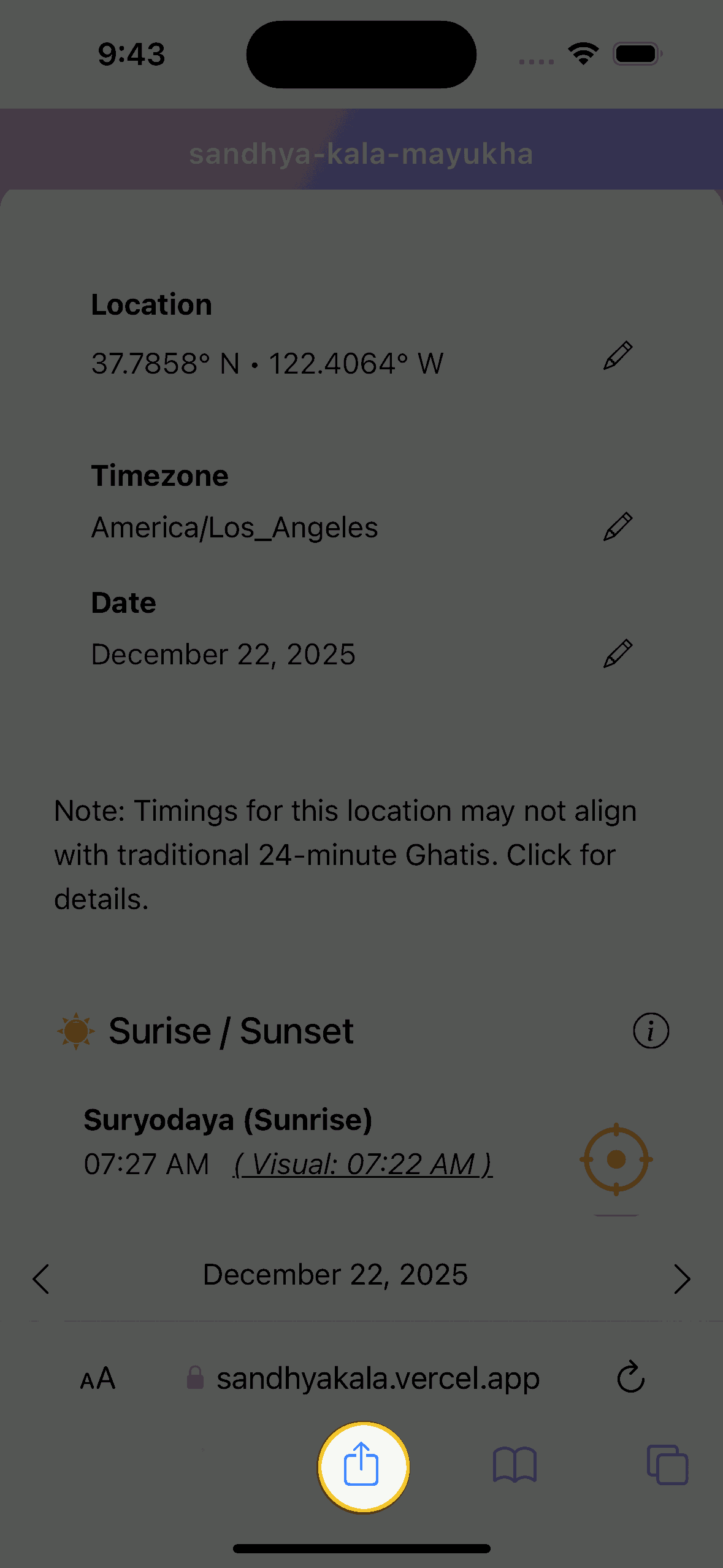
How to Install
Step 1
Tap the Share icon at the bottom.
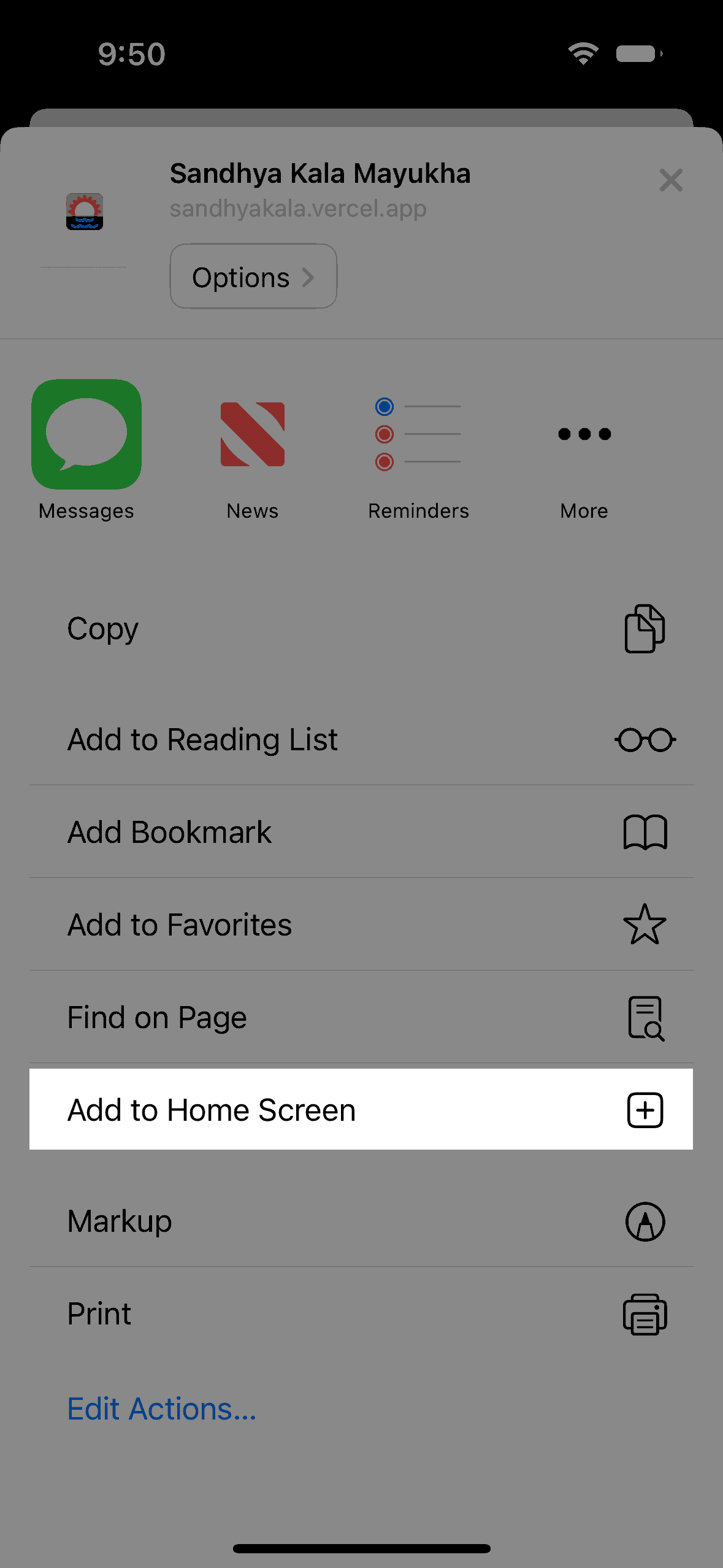
Step 2
Scroll down and select Add to Home Screen
Step 3
Confirm with Add button
App is installed
Preferences
Time Display
Appearance
Observance Level
"Detailed" shows Uttama, Madhyama, Adhama and Prayaschitta times. Simple shows only the whole timeframe of the Sandhya.
A new version is available.
Sandhya Kala Mayukha
सन्ध्याकालमयूखः
Precise Prātaḥ, Mādhyāhnika, and Sāyaṃ Sandhyā timings — calculated for your exact location, rooted in Dharma Śāstra.
Uncompromising Accuracy
Sandhyā times are not fixed — they shift daily with the sun. This app calculates them fresh, for your precise coordinates.
What it is
GPS Precision: Computed for your exact latitude, longitude, and elevation.
Astronomical Rigor: Powered by Jean Meeus algorithms — the gold standard in positional astronomy.
Offline Core: All kāla timings compute locally — no internet needed after setup.
What it is not
No Tracking: Your location never leaves your device.
No Ads: A clean, undistracted space for nitya karma.
Internet is used only once — for place-name lookup and elevation data.
Grounded in Śāstra
The kāla divisions displayed are not approximations. They follow the visual markers prescribed in the Smṛtis.
उदयात् प्राक्तनी सन्ध्या घटिकाद्वयमीरिता
udayāt prāktanī sandhyā ghaṭikādvayamīritā
"The morning Sandhyā extends two ghaṭikās before sunrise." — Smṛti-muktāphalam, Āhnika-kāṇḍam
Visual-First: Uttama, Madhyama, and Adhama kālas are defined by star visibility and solar appearance — not abstract geometric angles.
No Lax Interpretations: Prayāścitta windows are shown separately, clearly — not blended into the primary timings.
Sources Shown: Every timing comes with its scriptural basis. Tap ⓘ on any section to read the relevant Smṛti verses.
One Permission. One Purpose.
Sandhyā times vary by location. To calculate your kālas accurately, this app needs to know where you are.
Your coordinates are used only on your device to compute sunrise, sunset, and kāla divisions.
Location is never transmitted to any server for storage or profiling.
You can also set your location manually by tapping the pin icon on the main screen.